

Review: Outlive 25

A Brazilian classic that returns more strategic than ever

It is a great pleasure to have the opportunity to review Outlive 25, especially after already having contact with its demo version. For those unfamiliar, we are talking about one of the most important strategy games ever made in Brazil, originally released in an era dominated by giants like StarCraft, and which still managed to leave its mark with its own identity.
The narrative begins by establishing an interesting backdrop. At the beginning of the 21st century, humanity faces a severe crisis of mineral resources and a significant increase in global conflicts. In response, the World Council emerges, created in 2035 by leaders and major corporations, giving rise to the Outlive program with the goal of exploring resources beyond Earth. The choice of Titan as a destination leads to a central ideological conflict between two approaches, genetically modified humans or robots, something that is directly reflected in the gameplay.
GAMEPLAY
Outlive 25 maintains the classic essence of a traditional RTS. You build your base, manage resources, and must completely destroy your enemies. The simplicity of working with a single main resource, money, makes it easier to get into, but does not reduce the strategic depth.

The quality of life improvements are easily noticeable for those who played the original. It is now possible to define unit rally points more conveniently, including sharing the same point between multiple factories. Production queues are more organized, and visual indicators greatly help with readability, clearly showing the state of structures and units.
Among the new features, the replay system is one of the highlights. It allows you to revisit matches with full control, pausing, fast forwarding, or even removing the fog of war. More than just an extra feature, this turns the game into a learning and analysis tool, something the original never offered.

Another important change is the headquarters influence system. It creates an area where allied troops receive bonuses while enemy structures suffer penalties. This alters the pace of matches, reducing the strength of early rushes, although they are still a viable strategy. This change brings a more modern strategic layer, encouraging territorial control.
The differences between humans and robots remain a strong point. Each side has clear advantages, such as the robots’ energy independence, but nothing is absolute. The game continues to demand adaptation and reading the opponent, maintaining balance between the factions.
VISUALS AND SOUND
Visually, Outlive 25 presents a considerable leap compared to the original. The models are more detailed and well crafted, and it is noticeable that there was additional care in the final polish beyond the demo version. Even at higher resolutions, such as 1440p, the experience remains stable and enjoyable.
Even so, there are some questionable points, such as the lack of clearer resolution configuration options, which feels odd in a modern game. The interface could also use small adjustments, especially in areas like maintenance and research, which end up somewhat hidden within the UI.
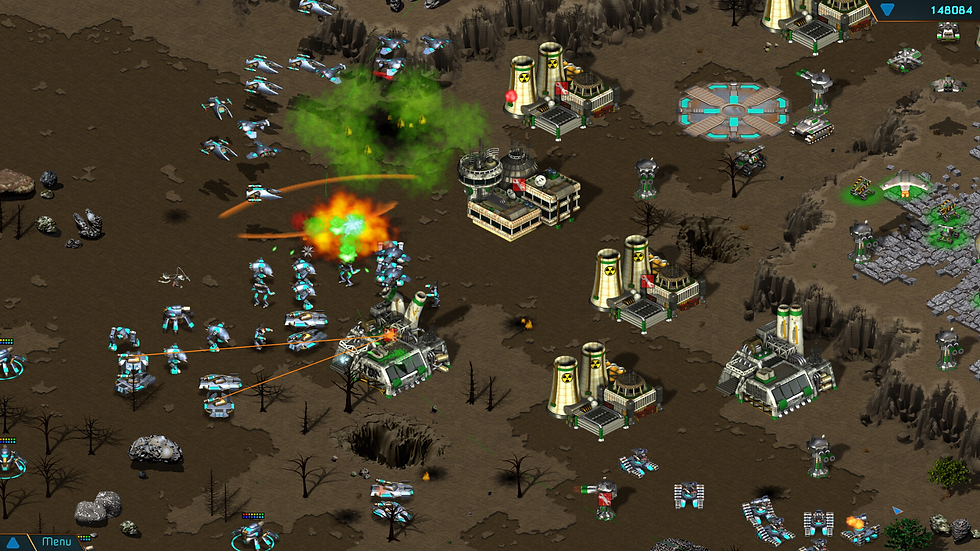
On the audio side, the game gets it right by maintaining its original identity. The soundtrack, with a strong heavy metal presence, remains extremely striking and helps reinforce the game’s atmosphere. The voice acting also remains one of the most memorable elements, bringing that nostalgic feeling for those who experienced the title years ago.
ACHIEVEMENTS
The achievement list in Outlive 25 is extensive and follows the player’s progression well. A large portion of them rewards natural actions during matches, such as producing units, eliminating enemies, destroying structures, and accumulating resources. This gradual progression helps keep the player engaged without forcing artificial objectives.

At the same time, the game also encourages the exploration of its deeper mechanics. There are achievements related to specific systems, strategic interactions, and even new features such as the replay system, reinforcing the analytical side of the experience. This shows a clear effort to make the game not only playable, but also something that can be studied.
For those seeking a greater challenge, there is a set of achievements aimed at more dedicated players, including campaigns on higher difficulties, long term goals, and full mastery of the mechanics. Overall, it is a well distributed system that caters to both casual players and those who want to extract everything the game has to offer.
TRAILER OFFICIAL
FINAL THOUGHTS
Outlive 25 is a clear example of how to revitalize a classic without losing its essence. It does not try to reinvent everything, but improves exactly where it needed to, bringing quality of life enhancements, modern tools, and strategic adjustments that make sense in today’s context.
At the same time, the game keeps intact the elements that made it special, such as its sound identity, straightforward gameplay style, and the balance between factions.
There are small points that could be refined, especially in the interface and in some usability decisions, such as a construction queue that could be automatically chained, among other things, but nothing that compromises the overall experience.
In the end, Outlive 25 achieves something difficult, pleasing both those who experienced the original and those who are just arriving now. It is a respectful and competent return that reinforces the historical weight of one of the greatest RTS games ever made in Brazil.
Review by Gamertag: Scoulz


Comments