

Review: Ace Combat 8: Wings of Theve

The sky belongs to those who can survive it

In Ace Combat 8: Wings of Theve, war once again reaches the continent of Usea years after the events of Ace Combat 7: Skies Unknown. The Central Usea Federation is still trying to rebuild after previous conflicts when the Republic of Sotoa launches a large-scale invasion. With its military forces under pressure and the city of Theve under threat, the FCU must reorganize what remains of its air power to face a force equipped with technologies capable of completely shifting the balance of the conflict.
It is in this scenario that we follow Rex and the crew of the aircraft carrier Endurance. After a series of events, Rex ends up assuming the identity of Jan Cope, known as Wings of Theve, a pilot transformed by FCU propaganda into a symbol of hope. Alongside Joker Flight and other squadrons, he takes part in increasingly large-scale operations, ranging from attacks against ground forces and escort missions to battles against enormous warships and superweapons. As the war progresses, the conflict between the FCU and Sotoa reveals much greater interests behind the battles, involving the Enso Order and establishing new connections to the future presented in Ace Combat 3.
GAMEPLAY

The preparation for each operation in Ace Combat 8 is extremely thorough and begins long before we even start the engines. The pre-mission briefing provides a complete overview of the battlefield: the regional map, date, exact time, visibility and cloud density, as well as the tactical objective. Knowing in advance that the main target will be a battleship makes aircraft selection genuinely important. If the operation requires a greater focus on ground combat, choosing a plane equipped for ground attacks becomes a strategic decision that directly affects the success of the mission.
The hangar system offers a very clear division of aircraft by role. Blue fighters are focused on air superiority and excel against other aircraft, while purple models take a multirole approach, perfect for players looking for balance. Red fighters are specialized ground attackers, ideal for tearing through tanks, artillery and naval fleets. In addition to choosing the main aircraft, we can install upgrades and configure which models our wingmen will use, creating tactics that carry from the planning stage directly into combat.
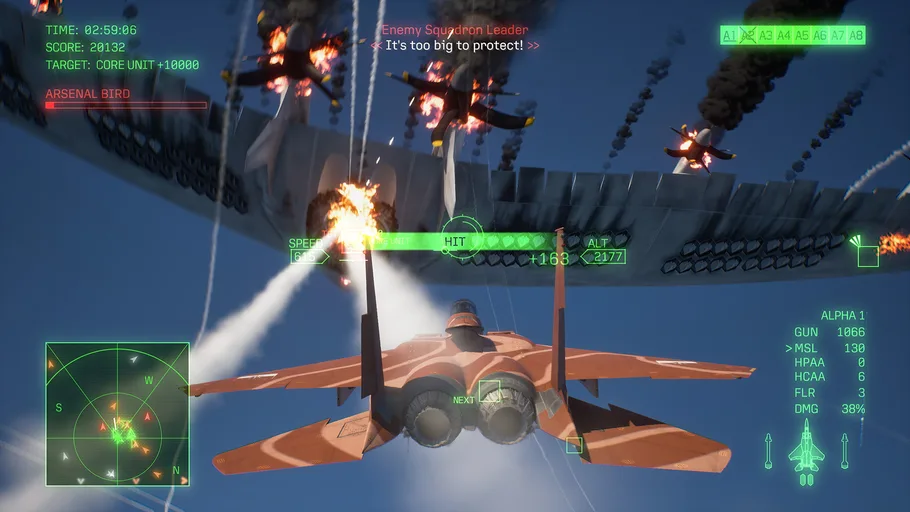
In conventional missions, the game maintains that pure arcade pace, with missiles crossing the screen and aircraft being destroyed within seconds. However, when facing a battleship, the player's approach has to change completely. You need to identify the ship's vulnerable points, coordinate your attacks, save special weapons for the right moment and understand from which angle the target can take damage. If one side of the ship offers fewer attack opportunities, you are forced to circle around and find a new position. Even the surrounding environment affects combat: if there is a building between your aircraft and the target, firing a missile too early will simply cause it to collide with the structure. These are moments that make the player slow down, study the map and plan the next maneuver, contrasting with the speed of normal aerial combat.
The difficulty curve follows your evolution as a player naturally. The early missions are simple and do a good job of introducing the basic systems, but the challenge gradually increases until you reach operations that demand much greater mastery of the aircraft and its resources. It is true that the menus and user interface (UI) throw a huge amount of abbreviations, statistics and technical information at you right away, which can feel somewhat cluttered for players unfamiliar with the franchise. However, it only takes a little time to adapt before you start quickly filtering the information that actually matters before each sortie.
Teamwork also plays a central role throughout the campaign. Being able to issue direct commands to allies and customize each member's aircraft adds an important tactical element. Beyond their practical usefulness, the wingmen have distinct personalities and a constant presence in the cinematics, giving Joker Flight and the other squadrons genuine narrative relevance. The main issue is their behavior when they are not under direct orders. During open combat without active commands, allied AI tends to become excessively passive, leaving most of the heavy lifting to the player. On the enemy side, AI alternates between impressive evasive maneuvers from enemy aces and somewhat predictable flight paths from secondary fighters.
Ace Combat Online

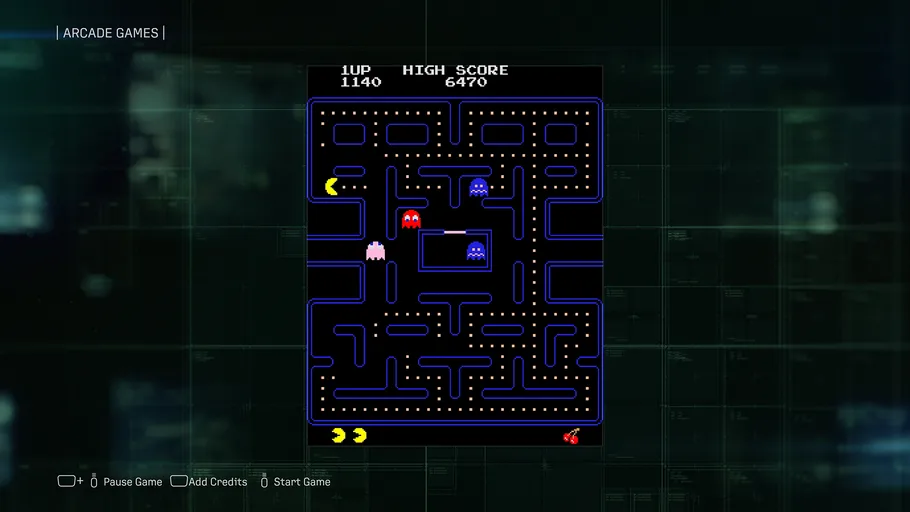
The content does not end with the campaign. Ace Combat Online considerably expands the experience by bringing players from around the world together in the same environment. The mode features its own avatar system, allowing players to customize characteristics such as hair and hairstyle, as well as a lobby where we can meet other players, chat, access the hangar, configure the squadron, take part in missions and complete training. There is also an arcade inside this space, featuring classic Namco games, which is a particularly interesting detail for anyone who appreciates the company's history.
The online mode offers several different activities, including attack missions, dispatch wars, emergency sorties, deathmatch, team deathmatch and special bounty contracts. There is also a shop with different currencies and content, including aircraft, skins, medals and other items. There is plenty of variety for anyone who intends to keep flying after finishing the campaign, giving the game longevity beyond its 30 main missions.

The Flight Stick Experience
My entire experience with Ace Combat 8 was played using a Thrustmaster T.16000M together with its throttle, and this made the experience even more interesting. There is a greater learning curve, especially at the beginning, because the number of commands and the way the aircraft is controlled require some adjustment. Still, the game allows this learning process to happen gradually. I did not need to be a simulator expert to adapt, and as the missions progressed, I noticed that I was using the equipment more naturally. The campaign's increasing difficulty matched this adaptation very well, and the feeling of mastering a maneuver or positioning the aircraft correctly after several hours with the flight stick is very different from simply playing through the entire campaign with a traditional controller.
VISUALS AND SOUND

Technically, Ace Combat 8 uses Unreal Engine 5 alongside Bandai Namco's proprietary technologies to render its environments and aircraft. The weather system also plays an important role, with dynamic atmospheric conditions that directly affect visibility and aircraft handling. This becomes even more important during certain operations because the weather is not merely a visual element in the background. It affects how we see the battlefield and control the aircraft. This combination also creates noticeable differences between operations, especially when moving from open environments to missions with more challenging weather conditions.
The soundtrack is another highlight. Night missions are a perfect example of how music, scenery and combat can transform an entire operation. When the sky is dark and My Blue Sky Home begins to play, we get some of the most memorable moments I experienced during the campaign. Some of these missions can last for dozens of minutes depending on the player's skill, and even then, I was never concerned about their length because I remained genuinely engaged with what was happening. The soundtrack also features violinist Lindsey Stirling, known for her work on YouTube and her appearance on America's Got Talent, whose contribution gives the game even more soul.
ACHIEVEMENTS
I really enjoyed the achievement list in Ace Combat 8, especially because it follows the campaign's progression very well and encourages players to explore different parts of the experience. Most objectives are unlocked naturally during gameplay, while others encourage greater exploration of the aircraft, weapons, upgrades, wingmen and different systems available. This makes achievement hunting feel closely connected to what the game offers, rather than turning completion into something completely separate from the main experience. For players who enjoy completing games, there is plenty to work toward after finishing the campaign for the first time.

My main criticism concerns the objectives tied to the higher difficulty levels. There is a requirement to complete the campaign on a specific difficulty, as well as a considerably more demanding objective that requires completing every mission on the highest difficulty with an S rank. Considering that some operations can already be quite demanding and that performance needs to be very precise at higher difficulty levels, this significantly increases the effort required to reach 100%. Even so, I liked the list as a whole, especially because of how well it follows the player's progression throughout the campaign.
TRAILER OFFICIAL
FINAL THOUGHTS
The main problem I encountered during the campaign is related to the time limit of one specific mission. In Mission 13, particularly during its final section, you have only two minutes to destroy approximately ten enemies. I persisted through this section and chose not to lower the difficulty, but at that moment I felt that the biggest enemy was not really the combat itself, but the clock. The time felt too tight considering the difficulty of the situation. This stood out to me even more because the rest of the campaign manages its pacing and objectives very well. In addition, the passivity of the wingmen when they are not given any orders can be somewhat frustrating.
It is difficult not to highlight how much the wingmen contribute to this experience. Their presence during operations, the commands we can give them, the ability to configure their aircraft and, most importantly, the personalities presented in the cinematics make them much more important than simply occupying space in the sky. Combined with the variety of the 30 missions, the preparation before each operation, the different aircraft classes, upgrades and battles against major targets, the campaign maintains a very high level of quality throughout almost its entire duration. My favorite mission was the first attack on the land battleship, precisely because it brings several of these elements together and requires a different approach compared to conventional combat.
Ace Combat 8 gave me the most enjoyable aerial combat experience I have ever had. The night missions accompanied by a memorable soundtrack, the constant progression in difficulty, the large-scale battles, the presence of the wingmen and, above all, the ability to play with a flight stick made a huge difference to my experience. The game is accessible enough for someone who is not a simulator specialist to learn, while also offering enough depth for that same player to notice their own improvement as they progress. I started out needing to adapt to the controls and ended up much more comfortable with the flight stick, making decisions about aircraft, weapons, allies and positioning almost naturally. With an exceptional campaign and an impressive variety of possibilities in each operation, Ace Combat 8: Wings of Theve establishes itself as a landmark for the franchise and as the most complete and enjoyable aerial combat experience I have ever had.
SCORE: 9.4/10
Review by Gamertag: SCOULZ


Comments