

Review: Company of Heroes 3: Final Stand

The battlefield changes, but strategy remains the greatest weapon
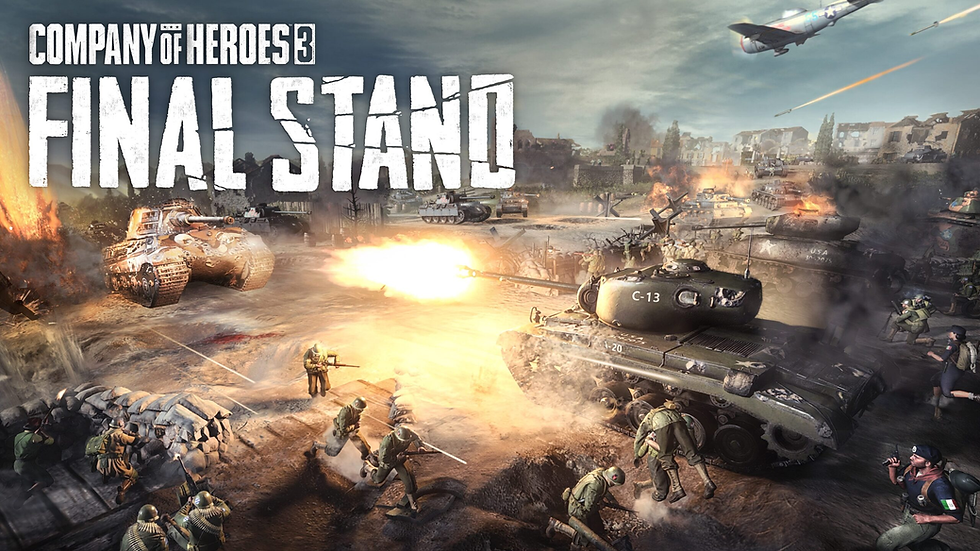
Final Stand abandons the traditional structure to focus entirely on surviving against waves of enemies, and I was curious to see if this change would actually work. Although it moves away from the campaign and territorial battles, the essence of the series remains present throughout the experience. Each match requires planning, adaptation, and quick decisions, especially because we never know exactly which technologies will become available during the run. This unpredictability, combined with the need to build an efficient defense against soldiers, vehicles, and increasingly dangerous bosses, kept me spending several hours trying to improve my strategies. At the same time, some design choices prevented the experience from being even better, especially when randomness interferes too much with the flow of matches or when certain limitations make battlefield management more difficult.
GAMEPLAY

The biggest change Final Stand introduces compared to traditional games in the franchise is the structure of its matches. Instead of capturing territories and pushing across the map, we must defend our Outposts while receiving resources automatically. This change shifts the entire focus toward preparation, positioning, and choosing the right units.
Before each wave, we have a short period to reorganize our defenses and select new technologies. This system is one of the most interesting parts of the experience, as we can receive new units, Commander abilities, or upgrades that completely change how we approach a match. In one playthrough, we can build a defense focused on paratroopers, while in another we have to work with whatever options become available at that moment.
However, this unpredictability also becomes one of the game's biggest problems. In one of my matches, I barely received any technologies related to tanks or anti-armor units, and when enemy vehicles started appearing, the situation became much more difficult. It creates the feeling that some battles depend more on luck than strategy.
The difficulty increases significantly during the final waves, especially when bosses and tougher units enter the battlefield. Company of Heroes still requires knowledge of each unit’s strengths and weaknesses, as simply placing several troops on the frontline rarely works. An anti-tank squad, for example, became one of the most important parts of my army during some battles.
The strategy that worked best for me was splitting my forces between defense and flanking. While one group held the main advance, another remained ready to attack from the sides and prevent enemies from overwhelming a single position. This type of decision shows that, even with the change in format, the strategic identity of the franchise remains intact.

The cover system also remains one of the biggest highlights. Using walls, abandoned buildings, and bunkers makes a huge difference in troop survival, especially during later waves. I also liked the ability to set the direction units are facing, something simple but very useful when creating defensive lines.
The Tactical Pause, activated with the space bar, is another essential tool. During chaotic moments, it allows players to better analyze the battlefield and reorganize their troops before the situation completely falls apart.
Despite that, some issues hurt the experience. The camera could be positioned farther away, especially on larger maps where controlling multiple groups becomes more difficult. I also encountered strange situations, such as a rock blocking my line of fire during a battle, preventing my units from functioning as expected.
The permanent progression through each faction’s benefits is a good addition, allowing players to improve reinforcements, vehicle durability, and other attributes. However, since each army has its own progression tree, the system encourages focusing on a single faction rather than developing all of them equally.
Overall, Final Stand succeeds at transforming Company of Heroes into a survival-focused experience, but some decisions, such as the lack of save options during matches and the absence of more detailed battle statistics after each run, make the experience feel less complete than it could have been.
VISUALS AND SOUND

Visually, Final Stand maintains the quality the franchise has shown in previous games. The maps feature plenty of detail, the units are well designed, and the battles still capture the feeling of a real conflict happening on screen. Explosions, vehicles, and troop movements contribute greatly to the immersion.
The sound design is also one of the highlights. Gunfire, explosions, and soldier communications successfully convey the weight of each confrontation. Even though this is a more limited mode compared to a full campaign, the presentation still maintains the identity of Company of Heroes.
ACHIEVEMENTS

The achievements in Company of Heroes 3: Final Stand are mainly focused on encouraging players to explore every possibility within the mode. Objectives such as earning a gold medal, winning without losing any Outposts, or defeating bosses in specific ways require players to better understand the defensive mechanics.
The most time-consuming challenges are connected to the four available factions, as players need to accumulate benefits while using each one. This encourages experimenting with different playstyles, but also requires dedication for those aiming to complete everything. Overall, the achievement list is balanced, avoiding extremely frustrating objectives while rewarding players who truly master the game's mechanics.
TRAILER OFFICIAL
FINAL THOUGHTS
Company of Heroes 3: Final Stand offers a different approach within the franchise and successfully adapts some of the series' strongest elements into a survival-focused experience. Building an effective defense, choosing technologies, and constantly reacting to enemy attacks creates intense moments, especially when stronger enemies appear and every decision starts to matter.
However, the biggest issue lies in its limited scope. Final Stand is a much smaller experience than a full Company of Heroes game, functioning almost like a separate mode that is restricted by the amount of available content. Despite having a strong strategic foundation, the lack of variety and some systems that encourage replaying the same battles repeatedly make the sense of discovery disappear faster than it should. The randomness of technologies can also create unfair situations, while the lack of saving options and some camera issues show that there was still room for more improvements.
It is an experience with good ideas that can provide enjoyable matches, especially for players who like testing different strategies or playing cooperatively, but it leaves the impression that Final Stand could have gone much further. With more maps, a greater variety of events, deeper progression, and additional quality-of-life improvements, it could have become a much more memorable addition to the franchise.
SCORE: 6.5/10
Review by Gamertag: Scoulz


Comments