

Review: Duskfade

An adventure that grows alongside its protagonist

In a world dominated by gears, clocks, and a night that seems to never end, Duskfade follows Zirian, a young apprentice who sets out on a journey alongside his mechanical companion Cuco to find his sister Allira. After the Clock Tower is taken over by Agony, the balance of this world is disrupted, forcing Zirian to travel through different regions while acquiring new abilities, facing creatures, and uncovering more about his family’s past. The adventure combines exploration, 3D platforming, combat, and character progression in a structure clearly inspired by the great games of the genre that defined the PlayStation 2 era, while using a modern presentation built in Unreal Engine 5.
Throughout the journey, Zirian gains new possibilities, discovers devices capable of changing his movement, finds hidden paths, and returns to previously visited regions to reach places that were previously out of his reach.
Duskfade places a strong emphasis on exploration and the gradual evolution of its mechanics, creating an adventure that starts relatively simple but steadily expands its possibilities as new abilities become part of the journey.
STORY
Zirian is a sweet and charismatic protagonist, with the personality of a dreamy boy who is always ready to discover something new. Allira works as an interesting counterpart, being more focused on building things and trying to find solutions to the problems that appear along the way. Tristan, their grandfather, is the character who constantly tries to keep both of them grounded, always with great calmness and compassion.
These are characters who spark curiosity, but they do not always receive enough room to develop everything they seem to have to offer.
I also felt that Allira needed a stronger emotional presence at the beginning of the adventure. The game quickly establishes that we need to find her, but I would have liked the story to give us a stronger reason from the very beginning to genuinely care about her. I understand the narrative choice made by the development team, and this relationship improves as the story progresses, but initially it did not affect me as much as it could have.

The scenes involving Zirian’s past, his sister, and Tristan are some of the moments that help the most in this regard. The animations are also very impressive. The facial expressions, character details, and the way they react during scenes are very well crafted. On top of that, practically everything is fully voiced, which gives the cast much more personality.
Agony also works well as an antagonist. At first, there is a sense of mystery surrounding her, along with the feeling that we are facing something genuinely dangerous. It is not an extremely complex story, but it works within the kind of adventure Duskfade is trying to create.
GAMEPLAY
It is in its gameplay that Duskfade begins to show some of its best qualities. Zirian’s movement is precise, which is essential in a platforming game. Running, jumping, rolling, attacking, and using different abilities during exploration all respond well to the controls.
Exploration is also quite rewarding. There are secrets scattered throughout the world, different collectibles, areas that initially cannot be accessed, and several types of upgrades. We can improve our weapons, abilities, devices, and resources related to Cuco through the progression system and the Traveler’s shop.
The progression system, however, is slow. This was one of the things I noticed the most during my playthrough. I would have liked some of the more interesting tools to become available earlier, especially because the initial combat is quite simple.
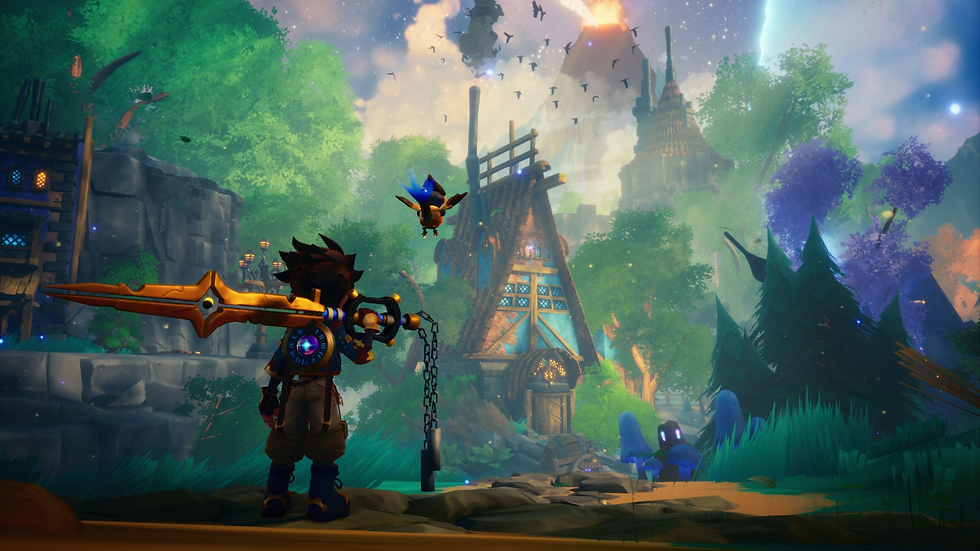
For a good portion of the beginning, we are basically attacking and dodging. Cuco can also participate in combat, and as we progress, new devices and abilities become available, but it took me a while to feel that the system was truly evolving.
The Pendulum is a clear example of this. It is only after a few hours, roughly three hours into the game, that we begin to have a greater variety of combos. I completely understand the intention of keeping these tools locked away to create a sense of progression, but I felt that this contributed to making the beginning of the adventure slower than it should have been.
The Chrono Shot is one of the abilities I liked the most. The Minuteria builds up energy and releases an extremely powerful blast, almost as if we were using a kind of shotgun. It is a simple ability, but it completely changes the way some enemies can be approached.
There is also a projectile parry mechanic that I found very interesting. Some attacks can be sent back at enemies and, in certain situations, the damage dealt by the reflected projectile is greater than the damage Zirian himself can inflict.

On the other hand, I felt that the game was missing a more complete defensive system. The roll is essentially our main defensive tool, and although it works well, I believe a block or another defensive option could have added a lot more depth to combat.
The camera also has some problems. There is a lock on system that can be used during combat and, in some situations, it works well. The problem is that it can be too automatic and end up directing our attention toward an enemy we did not even want to target. It does not always choose the closest enemy, which can become particularly troublesome in arenas with multiple opponents.
The enemies have some variety, but I felt that there should have been more differences between their attacks. Once we understand certain patterns, some encounters become predictable. Interestingly, the bosses perform better in this regard.
Exploration, however, has some orientation problems. Duskfade does not have a traditional map system. This can be interesting for players who enjoy memorizing environments and discovering paths on their own, but there were moments when I simply got lost.
What is even more curious is that even after replaying some areas, I still had trouble remembering exactly where certain objects were located.

There are bells that help locate certain objectives, and Fast Travel also makes navigation considerably easier. It even shows some of the collectibles we have left behind, which is quite useful for anyone looking to fully complete each region.
I also liked the way the game indicates when an area has been completely finished. For players who enjoy going for 100 percent completion, there is a clear incentive to return to the maps.
VISUALS AND SOUND
Visually, Duskfade is one of the adventure’s biggest highlights. The environments are beautiful and feature a very distinctive art direction, mixing fantasy, gears, crystals, and clockwork elements. The colors immediately stand out and, at times, the saturation can be excessive, but when the game does not push this characteristic too far, we get some truly impressive landscapes, such as Meridian Village.
The animations are also very well crafted. The characters’ facial expressions, visual details, and the way they move help considerably during the story scenes. It is one of those games where the characters can convey personality through their expressions alone, which fits very well with the adventure’s more charming tone.
The soundtrack fits the adventure very well, alternating between more dramatic themes and adventurous music during exploration. The voice acting also deserves praise and gives the characters more personality, particularly during the campaign’s story scenes.

The main problem is the PC version. I missed having more complete graphics options to properly configure the experience, and I also noticed some signs of a lack of optimization. Since the game does not allow me to control all of these settings in the way I would like, it is difficult to determine exactly how much of the performance is related to the configurations being used. It is a shame, because Duskfade is visually impressive and deserved a better prepared PC port.
ACHIEVEMENTS
Duskfade features 25 achievements worth a total of 1,000 Gamerscore, and the list is fairly well balanced between natural progression, exploration, and optional activities. Some achievements are earned simply by progressing through the campaign, while others encourage players to get to know the characters and regions of the world, find specific points of interest, and complete small activities scattered throughout the adventure. It is a list that fits well with the game’s structure without requiring players to do anything completely outside its intended experience.

For anyone going after all 1,000G, however, considerable exploration will be required. There are achievements related to collecting cards, music boxes, special items, health and temporal energy upgrades, as well as objectives involving characters and some hidden secrets. There are also simpler and more unusual tasks that reward players who pay attention to their surroundings and interact with situations that could easily go unnoticed. Overall, I found it to be an interesting list for players who enjoy completion, especially because it encourages you to discover practically everything Duskfade has to offer without revealing important story events.
TRAILER OFFICIAL
FINAL THOUGHTS
Duskfade has some clear problems. The map design could have been better, especially in the earlier regions, where the lack of a map can make exploration confusing. The camera also has issues during combat, and the target lock does not always select the enemy we want. Regular combat is also quite simple, especially at the beginning, with limited variety in enemy attacks, while progression takes a while to unlock the tools that actually make the gameplay more interesting. To top it all off, the PC version reviewed here offers very few graphics options, almost none, and a port that leaves something to be desired in several technical aspects.
Still, it is difficult to ignore the number of things I enjoyed during the campaign. Zirian’s movement is precise and becomes increasingly fun as new abilities are unlocked. The projectile parry mechanic, Chrono Shot, Pendulum, and different devices help transform the experience as we progress, while the bosses make good use of what we have learned throughout the journey. Exploration also has plenty to offer, with collectibles, secrets, upgrades, and areas that encourage players to return after acquiring new abilities.
Visually, Duskfade is also very impressive. Its environments are detailed, colorful, and full of personality, while the characters have great animations and expressions. The soundtrack fits the adventure very well, and the voice acting helps make the cast more charismatic. The story is simple, but it works within the game’s premise, especially because of the personalities of Zirian, Allira, Tristan, Cuco, and the various characters we encounter along the way.
In the end, Duskfade is an enjoyable adventure that takes a while to show everything it has to offer. It modernizes several characteristics of classic 3D platformers, while also repeating some familiar problems from the genre. I would have liked some systems to be more refined and for the PC version to have received more attention, but the precise movement, bosses, exploration, characters, and art direction make the journey worthwhile. I would mainly recommend it to players who enjoy 3D platformers and do not mind exploring a world that, at times, demands a strong sense of direction.
SCORE: 8.6/10
Review by Gamertag: Scoulz


Comments