

Review: EA SPORTS NHL 27

NHL 27 finds its rhythm between realism and fun

NHL 27 is one of those sports games that makes an impression within the first few minutes. The introduction has an almost television style presentation, looking beautiful and immediately putting the player into the atmosphere before the puck even hits the ice. The visuals are stunning, the arenas have their own identity, and the soundtrack stands out through its variety, ranging from classic rock to country and licensed songs that mix current tracks with already established hits. Even the classic sounds of the sport, including that characteristic piano and the traditional fights, help create an authentic experience.
GAMEPLAY
The gameplay foundation works very well precisely because it allows players to get started without having to master an absurd number of commands. Something that positively surprised me was the way matches can produce situations that feel like they happen spontaneously. The puck can completely change the course of a play after a collision, a battle for possession, or a loose puck, meaning that it is not always possible to predict exactly how a sequence will end. This unpredictability fits the sport very well and gives each match its own identity, especially when an apparently simple play ends up creating an unexpected opportunity. It is a characteristic that makes NHL 27 feel less restricted to predetermined sequences and more like an actual match where situations naturally develop as the players interact on the ice.
At the same time, there is a layer of depth that becomes apparent as you begin to better understand positioning, passing, movement, and different ways of creating plays. Passing plays involving the boards were one of the things I enjoyed most during matches, especially because directional passing allows you to create situations that go far beyond simply passing the puck to the nearest teammate.

The AI teammates also deserve praise. I felt there was a very interesting balance between realism and the movement of the AI controlled players, with teammates occupying spaces and participating in plays in an intuitive way. There are still some strange moments, especially when you look at a player's positioning or wonder why the AI made a particular decision, but these are isolated situations within a system that works very well most of the time. EA also reinforced the idea in NHL 27 that each team has its own tactical behaviors, with specific playbooks and strategy changes depending on how the game develops, which helps explain why different matchups can have very different rhythms.
Defense is an area where I noticed some inconsistencies. Puck pickup, or stealing the puck, whichever term you prefer, can be somewhat inaccurate in certain situations, and some of these interactions end up feeling less precise than they should. When I am facing another player directly, for example, I often feel that the puck steal could be more responsive. In practice, I end up relying on Body Checks quite frequently because the hit provides a much clearer sense of response to the command. There is also a considerable difference between simply playing NHL 27 and actually learning how to maximize its mechanics. This learning curve is one of the biggest I have seen in a sports game and it is great for anyone who enjoys going deeper, but it can also push away more casual players, especially online, where the difference between someone who has just started playing and an experienced player can be overwhelming.
GAME MODES
Franchise & Connected Franchise
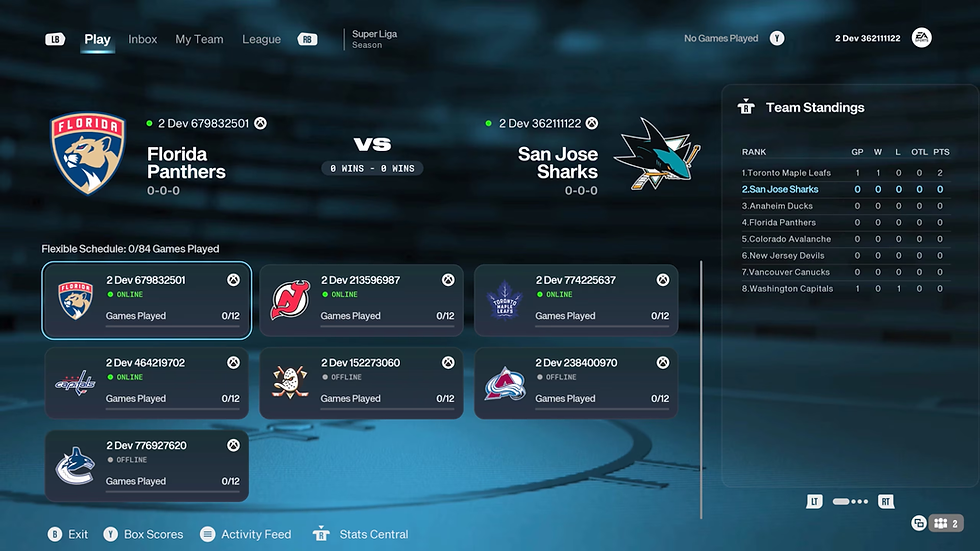
The Franchise mode follows a structure that will feel familiar to anyone who has played EA's sports games before. There are drafts, roster management, and several options for customizing the experience before even starting a season. For anyone already familiar with the Career Mode in FC or other titles from the company, there is not much of a learning curve here, but the number of available options allows you to build a very specific experience.
The arrival of Connected Franchise expands this concept into multiplayer, allowing players to create online leagues with friends and turn the season into an ongoing competition between different players.
Be a Pro
Be a Pro continues its focus on following a player's development within the world of hockey, but NHL 27 adds a greater layer of leadership to the career. Progression can involve leadership status, alternate captain and captain roles, as well as decisions related to the roster and the identity of the team. It is a natural evolution for a mode that has already received a lot of attention in previous games and works well with the idea of following not only the player's attributes, but also their position within the group.
Play Now

It was precisely in the offline one on one matchup that I had one of my most enjoyable experiences with NHL 27. The ability to simply choose two teams and step onto the ice allows all of the game's complexity to shine without having to go through menus, seasons, or progression systems. This is where passing, board plays, AI movement, physical contact, and the overall dynamics of the sport can work in the most direct way. For me, it was one of the most enjoyable experiences I have had with a sports game.
Ultimate Team

Ultimate Team follows the structure we already know from EA's games, with cards, roster building, and a huge number of menus. Visually, the card animations are very cool, including ice effects and the presentation dedicated to the items. It is also a mode with a huge potential to keep players engaged, since progression and the search for improvements naturally encourage consecutive matches. The biggest problem is navigation. At first, there is a feeling of sluggishness caused by menus on top of menus, tabs inside other tabs, and different screens before you finally reach what you actually want to do.
World of CHEL

World of CHEL is the part of NHL 27 focused on players who want to create their own character and participate in matches with other players, customizing appearance, play style, attributes, and equipment while developing their character. Progression takes place through different rewards and allows you to adapt your player to the position and play style you prefer to use on the ice.
In NHL 27, this system has been expanded with a Season Pass that offers Skill Points, Attribute Bonuses, Attribute Cap Increases, and cosmetic items as you progress. Another interesting detail is the influence of the character's physical size. Height and weight are not simply visual choices, as they also affect characteristics such as speed, agility, strength, balance, endurance, and the ability to perform certain defensive moves. This creates some interesting choices when building your player, since gaining strength and physical presence can mean sacrificing speed and agility. It is a mode with quite a lot to learn at first, but it gains depth as you understand how these characteristics affect your character's performance.
VISUALS AND SOUND
Visually, NHL 27 is one of those sports games that makes an impression without having to try too hard. The rebuilt arenas, the atmosphere of the matches, and the television style presentation fit the sport extremely well. The feeling of watching an actual broadcast also appears during the most intense moments, while celebration animations and the movement of the crowds give each match more personality. Some animations are a little too long and there are moments when they cannot be skipped, but that never bothered me significantly during my time with the game.

The soundtrack is one of the things I liked the most. It does not feel like it was simply put together with whatever songs are popular right now. There is a selection that mixes current licensed tracks with already established songs, ranging from classic rock to country, and that gives the soundtrack a lot of personality. The audio presentation during matches also works very well, from the characteristic sounds of hockey to the piano and celebration moments. The change to John Buccigross and Darren Pang as the broadcast team also gives the series a fresh identity compared to previous games.
ACHIEVEMENTS
NHL 27's achievements do a very interesting job of encouraging players to experiment with different modes and, most importantly, different mechanics throughout the game. Some of them are particularly fun precisely because they make you attempt plays that you might not normally use, such as scoring with a perfect one timer, scoring between the legs, or even knocking the goalie's water bottle off with a shot. There are also objectives that encourage players to explore less obvious mechanics, such as using the lacrosse shot, getting an assist with the lacrosse flip, or taunting an opponent with a deke. This makes the achievement list fit nicely with the game's learning curve and encourages players to put into practice what they have been learning during matches.

At the same time, some achievements require more dedication and introduce a certain amount of grind for anyone aiming for 100%. This is particularly noticeable in objectives tied to progression in specific modes, such as reaching level 50 in World of CHEL, completing a season in Connected Franchise, or reaching Gold Legacy status by retiring in Be a Pro. Even so, I like the way the list distributes its objectives between spontaneous moments and long term progression. You can unlock some achievements naturally while learning how to play, while others require you to genuinely commit to specific modes. For completionists, this variety makes the road to 100% feel less like a simple sequence of repetitive tasks, even though there are still some grind heavy moments along the way.
TRAILER OFFICIAL
FINAL THOUGHTS
The main issue I had with NHL 27 comes from some of the small inconsistencies during matches. Puck pickup can still feel inaccurate, particularly in situations where you expect a more direct puck steal, and some AI decisions make you stop for a second and wonder why a player moved that way. The number of menus also makes some modes slower than they should be, especially Ultimate Team. These problems do not ruin the experience, but they are noticeable during gameplay and prevent everything from feeling as fluid as it could. I also really missed having a Brazilian Portuguese translation, especially to make it easier to dive deeper into modes that involve so many menus.
On the other hand, the more time I spent playing, the more I enjoyed the possibilities offered by the mechanics. The initial accessibility of the controls combined with the difficulty of actually mastering every available tool creates a very interesting learning curve. Directional passing, plays involving the boards, teammate movement, and the variety of strategies can quickly turn a simple match into a sequence of decisions. The balance found in the movement of the AI controlled teammates was also one of the things I enjoyed the most, because there is a very satisfying feeling that the players are participating in the same play instead of simply following isolated commands.
In the end, NHL 27 is an extremely fun game once you start mastering what it has to offer. The offline one on one experience was one of the things that stood out to me the most. The presentation is also at a very high level, with incredible looking arenas, an authentic atmosphere, a very well selected soundtrack, and a broadcast presentation that fits the sport. There is still a huge difference between knowing how to play and actually mastering NHL 27, but that depth is precisely one of the things that made me want to keep playing.
SCORE: 8.7/10
Review by Gamertag: SCOULZ


Comments