

Review: FORENSIC - M.E. Protocol

Closer to an investigative laboratory than a police thriller, FORENSIC - M.E. Protocol embraces a slow pace and patient observation.
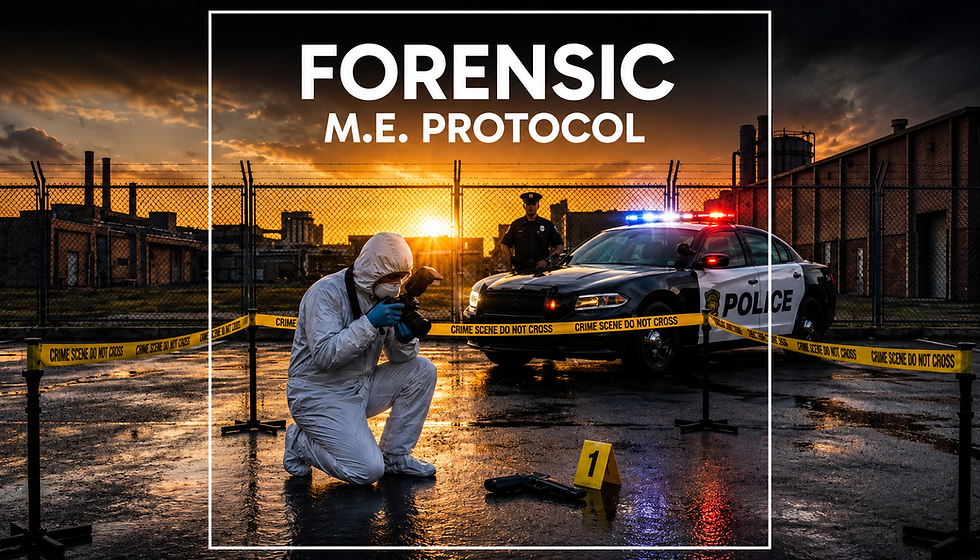
Investigation games usually follow relatively predictable paths. Many rely on cinematic storytelling, lengthy dialogue, or highly guided sequences where following markers is enough to trigger the next discovery. FORENSIC - M.E. Protocol attempts something a little different. Here, the goal is to place the player in the role of a forensic investigator who must observe, collect evidence, interpret crime scenes, and gradually build a logical sequence of what may have happened.
The structure revolves around nine standalone cases, each presenting different situations ranging from crimes of passion to kidnappings and scenarios that attempt to deliver small narrative twists. The intention is clearly not to create a spectacle-driven police thriller, but rather a contemplative experience where the player dictates the rhythm of the investigation.
The result is a game that finds its own identity precisely because it understands its limitations and works within them.
GAMEPLAY

The first thing that stands out in FORENSIC - M.E. Protocol is how it manages to create a surprisingly comfortable atmosphere despite its heavy subject matter. Investigating crime scenes could easily become an overly stressful or fast-paced experience, but the game moves in the opposite direction. You are given as much time as needed to analyze clues, inspect environments, use tools, and piece together events without artificial pressure.
The absence of a timer works extremely well within the game’s proposal. There is no constant sense of urgency that many simulators try to impose unnecessarily. The pacing is slow and almost meditative, encouraging observation over reflexes.

Crime scenes are generally organized in a very clear way. There is a visual logic that helps players understand environments and prevents them from feeling completely lost. However, there are moments where you need to suspend disbelief a little to accept some of the forensic simplifications. At times, it becomes difficult to ignore the feeling that fingerprints would realistically be scattered almost everywhere, rather than appearing only on the objects the game considers relevant.
Even so, this simplification appears to exist in order to avoid making the experience overly bureaucratic or frustrating.
The investigation system involves specialized tools, evidence analysis, marking important elements, and reconstructing parts of the crime. There are also devices such as drones and small robots used to access difficult locations, adding variety to the process without turning everything into excessive minigames.

On the other hand, some interactions require a short adjustment period. The game demands specific movements and, in certain moments, the interface can feel slightly rigid or unintuitive. It never fully compromises the experience, but it does require patience while learning how the game expects certain actions to be performed.
This reinforces a constant feeling throughout the experience: FORENSIC - M.E. Protocol is far more focused on contemplation than on immediate gameplay gratification. Anyone expecting something fast or action-oriented will likely find a much more methodical rhythm than anticipated.

At the same time, it is clear that the game knows exactly what it wants to be. There is confidence in its vision, even when technical limitations do not entirely match the ambition of the concept.
Narratively, the game functions in a relatively simple manner. The nine cases are independent and attempt to tell their own stories, each exploring a different context. These range from crimes of passion to investigations involving disappearances and more elaborate scenarios.
The narrative creativity exists, but within obvious limits. Dialogue between characters is limited and there is little room to deepen interrogations or ask truly meaningful questions to those involved. At times, it feels like certain cases could have become significantly stronger if there had been more space for deeper social investigation.
That does not mean the game fails in this area. It simply makes its priorities very clear. The story serves the investigation, not the other way around.
The overall impression is that the developers chose to focus their efforts on the investigative process itself, even if that results in simpler characters and more restrained interactions.
VISUALS AND SOUND
Visually, FORENSIC - M.E. Protocol delivers exactly what you would expect from a smaller-scale production. Environments fulfill their purpose by communicating crime scenes clearly and facilitating observation, though without major technical showcases.
The focus appears to be much more on investigative functionality than visual spectacle.

The atmosphere manages to maintain a coherent identity, largely thanks to the organized way environments are presented. There is clear care taken to make spaces readable for analysis, something essential in a game where paying attention to details is central to the experience.
On the audio side, the game follows a restrained approach without exaggerated dramatic moments. This works well with the contemplative tone, helping create a relatively comfortable experience despite the naturally heavy themes.
ACHIEVEMENTS
Right from the start, players receive basic objectives tied to the tutorial and first case, establishing a very straightforward progression system. Each investigation includes a ranking system, encouraging stronger performances by completing cases with a B rank or higher.
Mission names also help communicate the variety of investigative settings, including neighborhoods, roads, rooftops, forests, public bathrooms, and even a kidnapping case.

There is also an extra incentive for dedicated players through the “Forensic Master” achievement, unlocked by obtaining an S rank, suggesting an optimization layer for those interested in replaying cases and improving performance.
This structure works well because it offers a clear sense of progression without overwhelming players with excessively complex systems.
TRAILER OFFICIAL
FINAL THOUGHTS
FORENSIC - M.E. Protocol will probably not appeal to everyone, though it may not be trying to. The game finds a very specific niche by focusing on slow investigation, observation, and method, leaving action, urgency, and spectacle aside.
There are clear limitations, particularly in its simplified storytelling, less intuitive interactions, and certain realism compromises that require some goodwill from the player. Even so, it is difficult to ignore the merit of a game that understands its own proposal so well.
It delivers exactly what it promises, without major technical excesses or trying to present itself as something bigger than it actually is. For players who enjoy more contemplative investigative experiences and want something close to an accessible forensic simulator, there is value here.
Review by Gamertag: Scoulz


Comments