

Review: Necrophosis: Full Consciousness

An atmospheric nightmare built from flesh and sand

There are horror games that rely on cheap scares, constant chases, and excessive action to keep players under pressure. Necrophosis follows the exact opposite path. Its focus lies in contemplation, atmosphere, and especially in the way the world communicates its own decay through exploration.
From the very first moments, it becomes clear that the goal here is not to deliver fast-paced gameplay. Movement is slow, heavy, and extremely methodical. Every organic corridor, colossal structure, and deformed creature exists to be observed carefully. The game constantly invites the player to stop, look around, and absorb the grotesque details of its universe.
The narrative follows a world consumed by Necrophosis, a curse tied to the deterioration of existence and the gradual loss of consciousness. Throughout the journey, the player crosses regions that blend ancient civilizations, living flesh, and ritualistic structures while trying to understand the cycles of death, rebirth, and corruption that dominate this universe.
The story is told far more through the environment than through direct exposition. Bodies fused into walls, living monuments, scattered inscriptions, and grotesque creatures slowly help shape the player’s interpretation of what happened in this place. It is a game that clearly prefers suggestion over explanation.
GAMEPLAY
Necrophosis revolves mainly around interacting with the environment. Much of the experience consists of exploring grotesque areas, discovering organic mechanisms, activating structures, and completing small environmental objectives that unlock new regions.

This makes the pacing highly contemplative. Do not expect frantic action or complex combat systems. The focus is entirely on atmosphere, discovery, and the constant feeling of discomfort during exploration.
The level design does an excellent job of rewarding curiosity. Collectibles are scattered throughout nearly every area, including lore items, profane currency, and primordial inscriptions that expand the mythology of this decaying world. Players who enjoy careful exploration will constantly be rewarded for paying attention to every corner of the map.

At the same time, the extremely slow pacing may push some players away. In certain moments, progression becomes deliberately dragged out, and the game clearly prioritizes atmosphere over fluidity. Even so, this decision feels completely intentional within the experience it wants to create.
The most interesting aspect is how the world itself functions almost like the true protagonist of the game. The player is not there to conquer the environment, but to survive inside it while attempting to understand its grotesque logic.
VISUALS AND SOUND
Necrophosis’ greatest strength is probably its audiovisual direction.
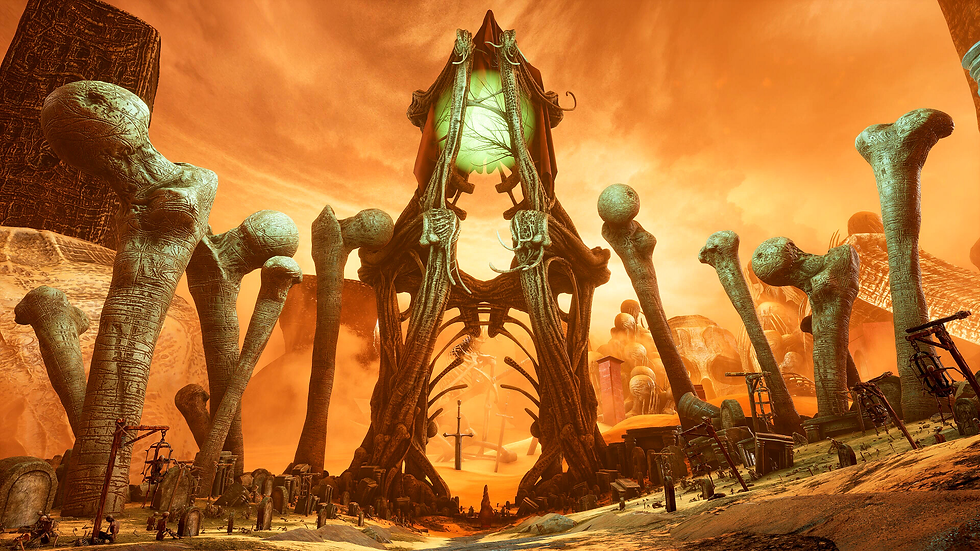
Visually, the game builds an incredibly grotesque yet fascinating universe. Everything appears to be made from bones, dried flesh, organic structures, and living monuments. The environments combine golden deserts, damp corridors, walls formed by distorted bodies, and creatures that seem to exist somewhere between the biological and the ritualistic.
There is a very strong emphasis on scale and visual composition. The player frequently feels insignificant in front of gigantic structures and monstrous entities spread throughout the world. This constantly reinforces the feeling of vulnerability.
The gore here is extremely graphic. Mutilated bodies, grotesque deformations, and visceral imagery appear throughout nearly the entire experience. This is definitely not a game recommended for players sensitive to body horror.

The sound design may be the most impressive element of the entire experience. The audio has a deliberately aged, muffled, and uncomfortable quality that amplifies the game’s oppressive atmosphere. Distant metallic noises, organic sounds, hollow echoes, and ambient tracks create a constant sense of unease.
This is one of those cases where sound is not simply a complement, but a central pillar of the experience. In several moments, the audio alone creates more tension than the creatures themselves.
ACHIEVEMENTS
The achievement list does a great job of reinforcing the game’s core themes. Many objectives emphasize exploration and environmental interpretation.
Achievements such as “Oppressive Intellect,” tied to collecting lore items, and “Titan's Desire,” connected to primordial inscriptions, encourage players to pay attention to details hidden throughout the world.
Others directly reinforce the game’s ritualistic and existential tone, such as “Lost Cycles,” “Will of Chaos,” and “The Divine Execution.” Even simpler achievements carry a strong sense of identity that helps strengthen the disturbing atmosphere of the journey.
It is also interesting how many achievements are tied to discovery and environmental interaction rather than purely mechanical challenges. This fits perfectly with the game’s slower and more contemplative nature.
TRAILER OFFICIAL
FINAL THOUGHTS
Necrophosis is an extremely specific experience that clearly does not attempt to appeal to every type of player. Its slow pacing, contemplative exploration, and obsession with atmosphere place it far away from most modern horror titles.
Players looking for constant action will probably struggle to connect with its design. However, for those who value strong artistic direction, environmental storytelling, and psychological horror built around atmosphere, the game offers a very unique identity.
Even with relatively simple gameplay systems, the combination of grotesque visuals, oppressive world-building, and exceptional sound design makes the experience memorable for most of its runtime.
Necrophosis successfully transforms discomfort, silence, and decay into its defining identity, creating a rare form of contemplative horror within the genre.
Review by Gamertag: Scoulz


Comments