

Review: ROLLA

Pixel Art, Destruction, and Casual Fun

ROLLA is an indie action and destruction game that puts players in control of a monstrous creature capable of consuming people, growing larger, and turning entire cities into wastelands. Developed by Tyrmä Games and published by Pantaloon, the game follows a concept reminiscent of Katamari Damacy, but replaces collecting objects with an experience centered on devouring humans, destroying structures, and surviving against the forces trying to contain the creature. With its retro aesthetic and exaggerated approach to horror, the game builds its identity around a simple idea, with much of the fun coming from discovering just how much chaos we can unleash.
Throughout each run, we must devour humans, vehicles, houses, buildings, supermarkets, and practically anything within reach. The creature grows as it consumes elements of the environment, while the police and military become increasingly dangerous threats. Progression revolves around specific objectives that vary from stage to stage, encouraging different ways to explore each environment. There are eight distinct stages, each offering enough variety to spark curiosity, although the number of tasks required to advance directly affects the overall pace of the experience.

The gameplay combines free movement, bursts of speed, and the ability to consume nearby targets in an accessible arcade structure. We use WASD to control the creature, the spacebar to perform dashes, and the mouse to consume nearby humans. During each run, we can find temporary power-ups that allow us to reflect projectiles or automatically absorb nearby people, providing useful advantages during more dangerous encounters. Growth also changes how we deal with threats, as human forces deploy increasingly dangerous weapons as the creature gets larger. This dynamic keeps the action moving without requiring complex systems or lengthy learning periods.
Progression is organized around objectives that resemble the structure of the Tony Hawk series, where completing specific tasks is essential to unlocking new areas. In ROLLA, we must accumulate a certain amount of damage, collect letters scattered throughout the stages, destroy a percentage of the available objects, or consume a specific number of humans. The challenges vary across the eight stages, which feature urban environments and other locations with distinct characteristics. The presentation also deserves attention: the isometric perspective follows the creature's movement, while a fictional television broadcast reports the situation as if we were watching live coverage of an unfolding catastrophe. The pixel art reinforces the game's retro identity, and the synth-based soundtrack complements the destruction.

MY IMPRESSIONS
The most enjoyable aspect of ROLLA is watching the creature grow as we turn the environments into scenes of complete destruction. Its inspiration from Katamari Damacy becomes apparent in the way size affects our interaction with the world, but the game establishes its own identity by placing humans, vehicles, and buildings at the center of the experience. There is immediate satisfaction in seeing objects that once stood in our way become easy targets, expanding our destructive capabilities. Since the controls are simple and the concept becomes clear within the first few minutes, the game quickly delivers what it promises without relying on complicated systems to keep players engaged.
The individual objectives also help give each run a sense of direction. Rather than simply moving through the stages and destroying everything, we must pay attention to the requirements for completing each level and unlocking the next ones. The variety of tasks, from accumulating damage to finding specific items and meeting consumption targets, encourages small changes in how we approach each run. This structure works particularly well because it provides clear goals without making their execution unnecessarily complicated. The problem becomes apparent when we consider the unlocking pace: the number of required objectives is relatively high, forcing us to replay the same stages several times before reaching new environments. Since the later stages are among the game's most interesting features, making them easier to access could improve progression without removing the importance of the challenges.
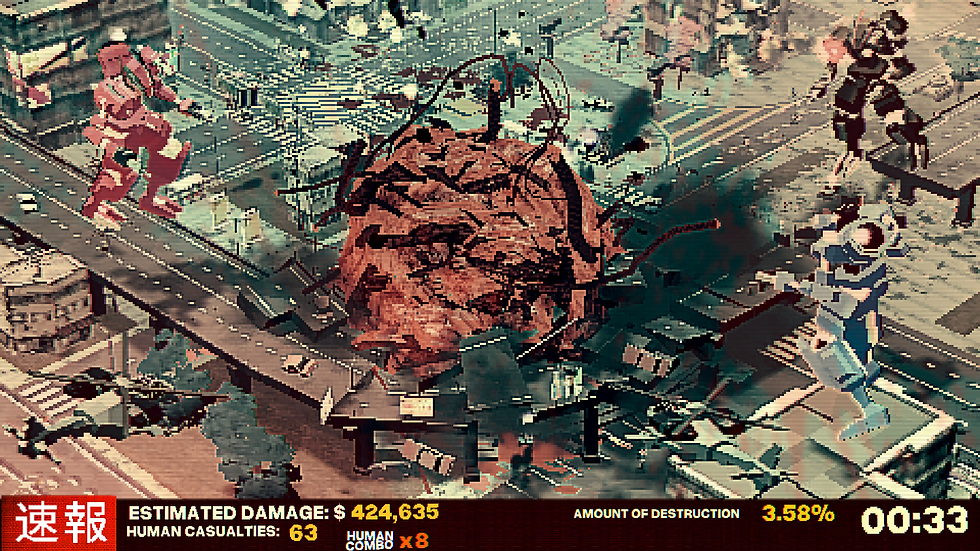
The art direction contributes significantly to the game's personality. The combination of pixel art, a grotesque creature, and urban environments creates a contrast that fits the dark humor of the premise. The presentation, inspired by a news broadcast, is another interesting touch, turning the player's destruction into an unfolding event covered on television within the game itself. This choice helps establish the context without relying on lengthy narrative sequences. The soundtrack complements the visual identity and works well during gameplay, although the music becomes noticeably repetitive after spending more time with the game. It does not ruin the experience, but a greater variety of tracks would help preserve the impact of the presentation throughout longer sessions.
During my tests, I also encountered some unusual behavior while loading stages. At certain moments, my computer appeared to freeze while the next level was being prepared, even though my system was considerably more powerful than the published minimum requirements. Once loading finished, the game ran normally again, which made it difficult to determine whether the issue was specific to my hardware or related to how the loading process is presented. Even so, a clearer visual indicator showing that loading is still in progress would help prevent players from thinking the game has stopped responding. It is a relatively minor issue, but worth mentioning because it affects the perception of stability, especially when players cannot tell whether they should keep waiting or something has actually gone wrong.

Another important aspect is how the experience changes as we progress. ROLLA is enjoyable when we want to spend a few minutes completing objectives and causing destruction without committing to a lengthy session. Over time, however, the repetition of activities and the need to revisit the same stages begin to reduce the initial excitement. I do not consider this a flaw that invalidates the experience, since arcade games can serve an important purpose by offering casual entertainment during moments of downtime. The point is that ROLLA works better in short sessions, with breaks in between, than when we try to play for extended periods. This does not diminish its merits, but it helps define the type of experience the game offers and the kind of player most likely to enjoy its mechanics.
ACHIEVEMENTS
ROLLA features 13 achievements covering progression, exploration, and different objectives completed throughout the game. The list fits the arcade structure well, encouraging players to experiment with the mechanics and pay attention to aspects they might otherwise overlook during their first playthrough. For achievement hunters, these goals add another layer of objectives beyond simply unlocking every stage. The relatively small number of achievements also makes progress easy to track without turning the list into an excessively lengthy checklist, keeping the focus on activities that are already part of the main experience.

On the other hand, completing the entire achievement list can require a level of repetition that is not always rewarding. Some cumulative requirements and specific conditions encourage additional runs, but when combined with the pace at which new stages are unlocked, they can make the pursuit of 100% completion excessively demanding. The problem is not asking players to explore different possibilities, but prolonging activities they have already completed several times without offering anything new in return. Those who simply want to enjoy the campaign do not have to worry about this, but completionists should be prepared to invest more time than the game's simple premise initially suggests. A better balance between the requirements would make the list more enjoyable, preserving the incentive to explore without turning full completion into a tedious task.
TRAILER OFFICIAL
FINAL THOUGHTS
ROLLA delivers an enjoyable arcade experience built around an easy-to-understand premise, accessible controls, and a good variety of objectives spread across eight stages. The creature's growth, environmental destruction, and increasingly dangerous human forces form a gameplay loop that works well, particularly during the first few sessions. The pixel art and presentation inspired by television news broadcasts help establish a distinct identity, while the stage objectives provide reasons to explore the environments and experiment with different approaches. The game finds its value in immediate fun and the freedom to cause destruction without requiring a major time commitment to start enjoying its mechanics.
Its main limitations lie in progression, repetitive activities, and the time required to unlock all the content. Having to complete numerous objectives before accessing new stages slows the pace, while the repetitive soundtrack and some demanding achievements can make extended sessions tiring. The unusual loading behavior observed during my tests is also worth mentioning, although I could not determine its cause. Overall, ROLLA is an interesting option for anyone looking for a casual experience, particularly when played in short sessions. Its strengths are clear, but more balanced progression and a greater variety of gameplay elements would help sustain the fun for longer without requiring players to return to the same activities so many times.
SCORE: 8.0/10
Review by Gamertag: SCOULZ


Comments