

Review: Echoes of Aincrad

An adaptation that faithfully recreates one of anime's most memorable worlds.

Sword Art Online has always had a premise that seemed perfect for video games: living inside an MMORPG where every battle, level gained, and decision becomes part of a fight for survival. Echoes of Aincrad embraces that concept by placing players directly into the world of Aincrad, allowing them to create their own character and experience the early events of the series from a fresh perspective.
Unlike previous adaptations, the adventure is not centered solely on Kirito. Familiar characters such as Asuna, Argo, and Kirito himself remain part of the story, but players take on the role of another survivor trapped inside the game, struggling to grow stronger and find their own path through that world.
The opening hours, however, take a while to reveal the game's full potential. The prologue keeps players confined to enclosed environments for an extended period, functioning almost entirely as a lengthy tutorial while introducing the core mechanics. This approach fits the initial feeling of being trapped inside Aincrad, but it also delays the moment when the game begins to showcase its strongest qualities.
Once that introductory section is finally over and players begin exploring the open areas, towns, and landscapes, it becomes much easier to understand what Echoes of Aincrad is trying to accomplish: transforming one of anime's most iconic settings into a world where players can truly forge their own adventure.
GAMEPLAY
Echoes of Aincrad features a straightforward combat system that fits the spirit of the franchise well. Players have access to basic attacks, guarding, dodging, and special abilities inspired by the anime's Sword Skills. The game does not attempt to build an overly complex combat system, but battles successfully capture the feeling of using techniques within an MMORPG.
The highlight of combat lies in the Companion combo attacks. Throughout most of the campaign, using your allies' abilities effectively is one of the best ways to deal damage and control encounters. It is a simple mechanic, but one that fits naturally within the game's design.
Equipment progression also follows an interesting approach. The game consistently rewards players with new gear after defeating monsters and bosses, while allowing older equipment to be used as upgrade materials for newer items. This design avoids the common RPG frustration of spending countless hours waiting for a single piece of equipment to finally drop.
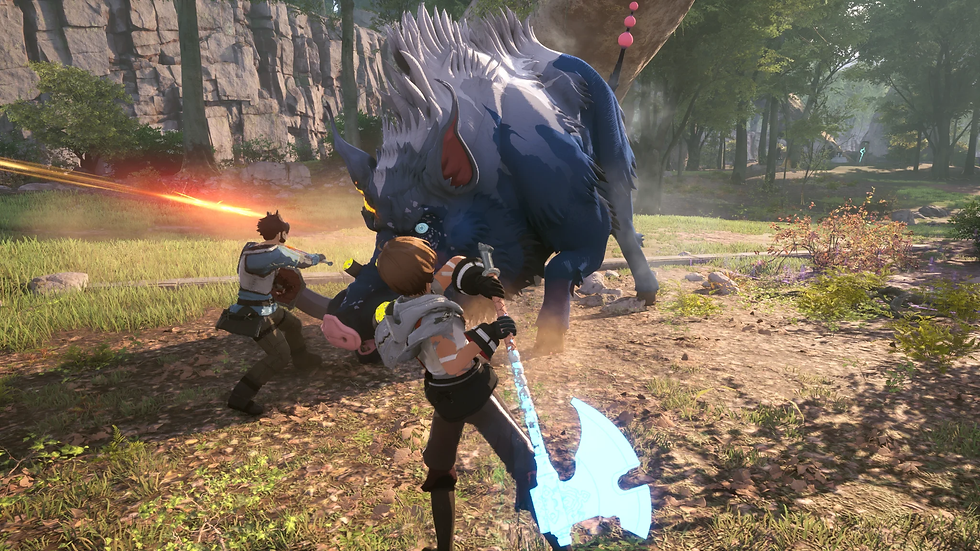
Exploration takes place across semi-open maps that gradually become available as players reach key points in each region. The overall structure works well, although some locations feel larger than the amount of meaningful content they contain. Repetition becomes noticeable as enemies, objectives, and routes begin to repeat themselves more frequently.
The Cave of Tears is one of the clearest examples of this issue. Visually, the dungeon offers an appealing atmosphere, featuring effective lighting and environments that create a strong sense of immersion. However, its layout is confusing, and the repeated environmental structures make exploration less engaging than it could have been.

Customization also offers plenty of freedom to tailor the experience to each player's style. As the character evolves, new attribute points can be allocated to boost specific traits, while the variety of weapons, gear, and skills allows for builds geared toward offensive, defensive, or balanced playstyles. It may not offer the depth of major MMORPGs, but it provides enough options to make progression feel personal and encourage experimentation with different combat approaches.
One particularly unusual design choice is the character creation system. Instead of appearing at the beginning of the game, players only gain access to it after several hours of gameplay, which differs from the standard RPG formula. It makes sense within the story, but those expecting to customize their character immediately may find the decision surprising.
VISUALS AND SOUND
One of Echoes of Aincrad's greatest strengths is the way it recreates the world of Sword Art Online. After the more visually limited opening section, the open environments display a much stronger artistic direction, particularly in the design of towns and natural landscapes. The Town of Beginnings stands out as an excellent example, delivering a layout that genuinely feels like a living MMORPG while faithfully reflecting the architecture of the anime.
The caves also demonstrate careful environmental design. Even when their layouts are not particularly enjoyable to navigate, there is a clear effort to make these locations visually memorable through varied lighting and environmental details that prevent them from feeling like endless identical corridors. The result is an interesting contrast, as some of these areas are beautiful to look at despite being less enjoyable to explore.
From a technical standpoint, the game performs very well on Xbox Series X. Both Quality Mode and Performance Mode provide a stable experience, although Performance Mode stands out thanks to its smooth frame rate during both exploration and combat. Even in larger environments, the adventure remains consistently fluid without noticeable drops that negatively impact gameplay.

Although the overall quality of the textures and environments is impressive, some visual elements could have received additional polish.
Lighting occasionally falls short of the standard established by the rest of the presentation, especially regarding the shadows on major characters and NPCs. These are relatively minor issues that do not significantly affect the overall experience, but they do create a visible contrast between the quality of the environments and the character models.
On the audio side, offering both Japanese and English voice acting is an excellent decision for a game based on such a popular anime franchise.
The Japanese voice track feels especially authentic to Sword Art Online and helps preserve the connection with the original series. The opening theme also deserves recognition, delivering a composition that perfectly matches the sense of adventure while reinforcing the feeling of returning to the world of Aincrad.
ACHIEVEMENTS
Sword Art Online: Echoes of Aincrad features a fairly traditional achievement list for an RPG, with objectives divided between story progression, character development, exploration, and equipment upgrades. Players will unlock achievements for visiting Aincrad's major towns, including the Town of Beginnings, Horunka, Tolbana, and Urbus, as well as objectives tied to companions, allowing them to form partnerships with familiar characters such as Kirito, Asuna, Agil, Silica, Lisbeth, and Klein.

There are also numerous achievements aimed at players who want to experience every system the game has to offer. These include collecting different weapon types, unlocking Sword Skills, fully upgrading weapons, completing the monster and character databases, defeating bosses, and reaching high character levels. The final achievement, Nameless Hero, naturally requires completing every other objective, serving as the ultimate reward for players determined to experience everything Aincrad has to offer.
Although the achievement list is well structured and covers every major aspect of the game, I found it somewhat lacking in creativity. Most objectives follow familiar RPG conventions, such as visiting specific locations, earning a certain amount of money, defeating a set number of enemies, or collecting equipment. They effectively accompany the player's journey, but the game could have done more to embrace Sword Art Online's unique premise by including challenges that better capture the fantasy of being trapped inside Aincrad or memorable references that longtime fans would immediately recognize.
TRAILER OFFICIAL
RESUMO
Echoes of Aincrad presents one of the most compelling concepts the Sword Art Online franchise has ever explored in video games. The opportunity to create your own character and experience Aincrad as another player trapped inside the floating castle is exactly the fantasy many fans have imagined ever since watching the anime.
The game is at its best when it allows players to freely explore its environments, discover its towns, and experience a world that feels alive and believable. The recreation of Aincrad, the numerous references to the anime, and the inclusion of beloved characters demonstrate genuine care for longtime fans of the series.
However, several design choices prevent the experience from reaching an even higher level. An overly lengthy introduction, repetitive activities, inconsistent level design in certain areas, and exploration that does not always match the visual quality of the environments occasionally slow the pace of the adventure.
Even with these shortcomings, there is something genuinely special about finally walking through Aincrad, developing your own character, and taking part in a journey that once existed only on the anime screen. Echoes of Aincrad remains faithful to the essence of Sword Art Online while offering fans the chance to experience its world from a completely different perspective.
With a stronger sense of pacing and greater gameplay variety, the game could have reached even greater heights. Even so, it remains one of the closest adaptations to the adventure many players imagined when they first discovered Aincrad.
SCORE: 7.6/10
Review by Gamertag: Scoulz


Comments